







Name-Surname: Tears From Laughter
When government officials have to hold population and housing censuses for people of ethnic groups, unfamiliar sounds and dialects may lead to incorrectly funny names being recorded. Apparently, they are difficult to change.
Story by Chayaphon Tipatueng
Story of Yuan
Location: Mae Chan, Chiang Rai
~~~~~~~~~~~~~~~~~~~~~~~~~~~
Talking about the origin of surnames, we probably have to go back to the reign of King Rama VI, who enacted the Surname Act on 22 March 1912, effective on 1 July 1913, introducing surnames to Thailand, as well as conferred surnames to 6,432 families. Many families designated their surname after the family’s leader or after place of residence. The first surname in Thailand ever is “Sukhum”.
In total, the King Rama VI has conferred 6,464 surnames, divided into as follows:
-
6,439 surnames in the registry book
-
1 special surname: Na Pitsanulok
-
24 surnames for King Rama IV’s royal houses, i.e. Kridakorn, Kasemsri, Khamdee, Jakkrapan, Jittrapong, Chaisawat, Chumpol, Taweewong, Lertrattanarangsi, Tongtaem, Talumartsawat, Ditsakul, Tewakul, Nueangmatcha, Nisaratkul, Pimsan, Pawakkapan, Srithawat, Sornlum, Sawaddikul, Sawaddirat, Humpanon, Singkhala, Singhakhala, Hatbumroe.
Since the promulgation of the Surname Act, Thai citizens are required to have a surname for use within the family. The popular naming choices include:
-
After ancestors’ name (grandparents)
-
Civil servants holding royally-conferred title usually designated their surname after it, for example surname “Phibunsongkhram” was named after Luang Phibunsongkhram (Plaek)
-
After place or district of residence
-
Thai-Chinese citizens might translate their “Sae” or clan name, or put the word “Sae” in front of the new surname, or put the clan name as the first syllable or within the new surname.
-
The King’s grandchildren (Mom Chao), great-grandchildren (Mom Rajawongse), and great-great-grandchildren (Mom Luang) used their royal house name as surname. However, the children, grandchildren, and great-grandchildren of Mom Luang might not use the royal house name alone, but also add “Na Ayutthaya” at the end.
The Person’s Name Act B.E. 2505 (1962) stipulates rules for the designation of surnames, as follows: Section 8 Surnames shall
(1) not resemble or intended to be similar to the King’s title, or the Queen’s title;
(2) not resemble or intended to be similar to the title conferred by the King, except for his or her own, or the ascendant’s, or the descendant’s title which was conferred by the King;
(3) not repeat the Surname conferred by the King or the registered Surname;
(4) not contain an offensive term or meaning;
(5) not comprise of more than 10 alphabetical letters, except where the title conferred by the King is used as a Surname.
~~~~~~~~~~~~~~~~~~~~~~~~~~~
Sometimes, you do not need to be a fortune teller to know the family or ethnic background of a certain group of people by just looking at the surname. What about an ordinary person like us? Can our surname indicate our ethnicity or origin to the same extent? The author would like to provide some examples below. The author apologizes in advance, if any of the readers’ surnames appears in this article.
-
In the Lahu ethnic group, male first name usually begins with “Ja…”, while female first name usually begins with “Na…”. A Lahu unique surname is “Lahuna”.
-
In the Mien or Yao ethnic group, most common surnames include “Sae Tern”, “Sae Wang”, and “Sae Jao”.
-
In the Akha ethnic group, male first name usually begins with “A…”, while female first name usually begins with “Mi…”. Surnames vary, such as “Ma Yer”, “Mor Po Gu”, “Cher Mue”, etc.
The reader may have heard funny names or surnames that made you laugh, especially those of ethnic people. Behind the laughter hide their tears.
Enough with the detour, how is this related to the topic of this article?
The reader may have heard funny names or surnames that made you laugh, especially those of ethnic people. Behind the laughter hide their tears. For many ethnic minorities, name change is quite a complicated thing and it affects the result of their application for legal status and/or nationality. We have to go back again to the survey and registration of highlanders in 1990-1991 and the survey of the highland communities in 1998-1999, which targeted “hill tribe people” and “minority groups” in Thailand for census purposes. That was where the problem originated.
Most public officers are lowlanders or people from other regions with a different dialect and language from those in the north. With the “hill tribe people” and “minority groups”, however, the communication gets even more difficult, which often leads to misunderstanding.
An example includes when officers record data about the relationships within the family where the husband and wife have the same parents. Another major issue concerns the place of birth and the year of entry to Thailand from Myanmar, which affects the nationality criteria. In one family, it has been found that the head of the household immigrated from Myanmar in 1987 and the son was born in 1999, but the official record indicated that he was born in Myanmar due to language barrier. The error was obvious. Nevertheless, the son had to go through a complicated process in order to correct it later. And this problem was only caused by a misunderstanding, which could have easily happened.
Now, here are some stories that the author would like to share with the reader. The first one… I don’t know if it is a funny or a rather sad story. Normally, when a baby is born at the hospital, the form Tor Ror 1/1 Part 1 is issued by the hospital to register birth or issue a birth certificate.
For a baby of a Thai citizen, Tor Ror 1 is issued.
For a baby of a non-Thai citizen, Tor Ror 3 is issued.
However, for a baby of a stateless person, Tor Ror 031 is issued.
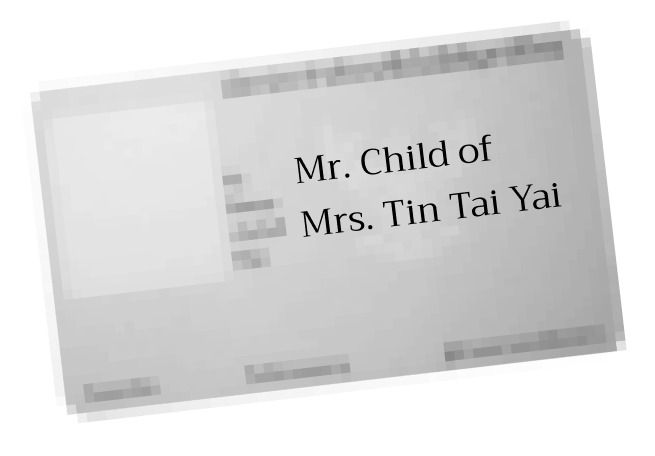
In case of the latter, the Tor Ror 1/1 Part 1 Form does not indicate the name of the newborn baby, only “Child of Mrs…”. What’s odd, when the parents go to register the birth, the birth certificate also says “Mr. Child of Mrs. Tin Tai Yai (Shan ethnicity)”. Until today, he is still unable to change the name because he is yet to obtain Thai nationality.

The next story is about an officer's handwriting. As we all know, public health staff have a way to read and write and understand things within their own group. People from other professions may have to have the content analyzed in order to understand their message. The burden lies on the officer at the Registration Office to decipher the handwriting. In this case, the girl’s real name is “Ms. Muay Khammoon”. However, due to the sloppy “u”, she is officially called “Moay (pubic hair) Khammoon”.
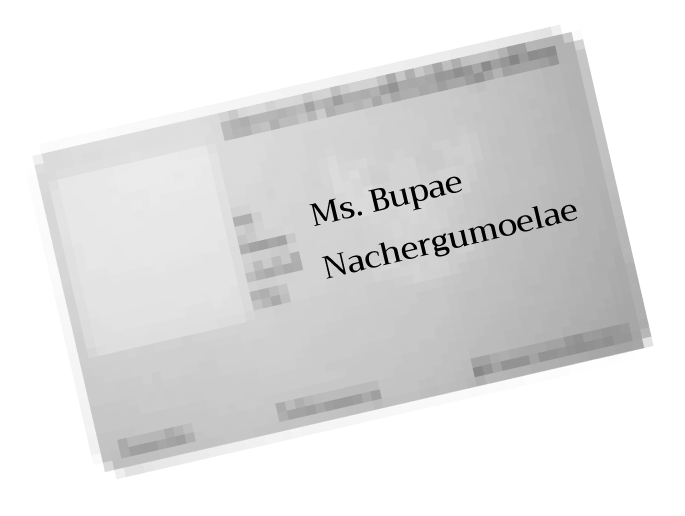
Another case concerns a miscommunication regarding the surname. A woman’s name was registered as “Ms. Bupae Nachergumoelae”. In reality, her surname is “Muelae”. However, during the interview with the officer, the woman’s father might want to say “surname (Namsakul) [is] Muelae”. But because he could not pronounce it clearly, the officer registered the name as above.
Who is to blame?
Who is responsible?
How should we solve this?
Improving the people's pronunciation?
Increasing the authorities’ ability
to understand?
Or amending the law
so it truly serves the citizens?
Another case concerns a miscommunication regarding the surname. A woman’s name was registered as “Ms. Bupae Nachergumoelae”. In reality, her surname is “Muelae”. However, during the interview with the officer, the woman’s father might want to say “surname (Namsakul) [is] Muelae”. But because he could not pronounce it clearly, the officer registered the name as above.
At this point, the reader may think “and so what? Isn’t it a common case of error that can be easily fixed?”. Well, yes and no. According to Item 115 of the Regulations of the Central Registration Office regarding the Civil Registration B.E. 2535 (1992) (2nd Amendment B.E. 2551 (2008), anything may be corrected. However, as I have mentioned many paragraphs earlier, such correction will result in discrepancies in different documents and thus affect the application for Thai nationality. The registrar may not believe that documents really belong to the applicant. An additional witness inquiry may need to be conducted. Or worse, in case the registrar uses his/her discretion to deem the documents incredible, a costly DNA test may be requested. Hence, most advice is to “avoid altering any information in the civil registration as long as one does not have Thai nationality yet”. So, these people are stuck with these ridiculous and bizarre names until they become Thai nationals. Can the reader imagine how lengthy and difficult the whole process takes?
Some people had to live with it until the day they died because they never met the legal qualifications.
Who is to blame? Who is responsible? How should we solve this? Improving the people’s pronunciation? Increasing the authorities’ ability to understand? Or amending the law so it truly serves the citizens?
This story is the product from the series of workshop on “Creative and Strategic Communication for Sustainability” organized by UNDP and Realframe with the support from the EU
References
1. https://th.wikipedia.org/wiki/นามสกุล
2. https://pantip.com/topic/38979328
3. https://ap4.salesforce.com/a0m6F00000G1rU4?srPos=0&srKp=a0m
4. https://ap4.salesforce.com/a0m6F00000HCTrN?srPos=1&srKp=a0m
5. Stateless Persons Database of ADRA Thailand
6. Regulations of the Central Registration Office regarding the Civil Registration B.E. 2535 (1992) (2nd Amendment B.E. 2551 (2008))
1. https://th.wikipedia.org/wiki/นามสกุล
2. https://pantip.com/topic/38979328
3. https://ap4.salesforce.com/a0m6F00000G1rU4?srPos=0&srKp=a0m
4. https://ap4.salesforce.com/a0m6F00000HCTrN?srPos=1&srKp=a0m
5. Stateless Persons Database of ADRA Thailand
6. Regulations of the Central Registration Office regarding the Civil Registration B.E. 2535 (1992) (2nd Amendment B.E. 2551 (2008))
Written by
Chayaphon Tipatueng
A developer who is passionate about the social development work. Currently working for the international non-governmental organization.
 Becoming Home